 |
 |
More about COVALENT BONDS Co=together
Valent=value1. Why don't atoms that are connected by a covalent bond fly apart? To begin to understand this, let's take the example of two hydrogen atoms that share electrons.
A hydrogen atom, the simplest atom, consists of only a nucleus with a single positive charge surrounded by one electron that is negative. You would think that the two positive nuclei would repel each other, because similar charges repel.
The secret is that the shared electrons are very likely to be found between the two nuclei, so that you have an attractive force between the positive nuclei and the electrons that are in between. That attraction is even stronger than the repulsion of the two positive nuclei.
All covalent bonds are like this, resulting in shared electrons spending some of their time between the two nuclei. The more likely it is that the electrons are found between the atoms, the stronger is the bond.
[Make a cartoon of 2 positive nuclei pushing against each other and the cloud of shared electrons in between pulling on the nuclei.]
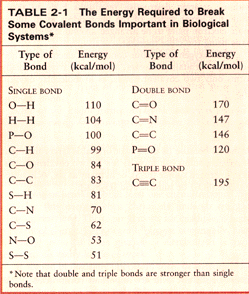
2. Covalent bonds linking atoms to each other are strong, requiring a great deal of energy to break. As you can see from the chart below, most covalent bonds have energy that is between 50 and 200 kcal/mol ("kilocalories per mole"). But the bond holding water together (H2O) is even harder to break apart, at 220 kcal and CO2 is 340.
(This means that these states are energetically favorable, which is why they are often found at the end of metabolic processes of living beings. )
|
|
|
BACK TO BONDS
Index